Showing posts with label Economics. Show all posts

Tuesday, August 11, 2020

Economic Principles in Games


Dr. Wictz talks about Economic Principles in Board Games with Dustin on the Board Gaming with Education Podcast.  We talk about how and why to utilize Economic Principles in game design and how to use games with Economic Principles as a teaching tool.


Thursday, November 15, 2018

Real World Mechanics Nessicate Innovation

An obstacle to implementing a real world mechanic is translating that mechanic into a functioning mechanic in a board game.  Many real word mechanics have yet to be built into a board game design, so the problem of making rules and and a board game interface is key challenge for creating a real world mechanics board game.  To successfully create a real world mechanic board game, the designer must innovate.

Take my game Bookies & Bettors. Bookies & Bettors is a horse betting game where players experience the thrill of making bets with other players in a betting market modeled on naked short selling. In the real world, a betting market's primary purpose is to facilitate trading information.  A bet communicates information between the bettors. One bettor has information a horse is going to improve and the other bettor has information the horse is falling back. Skilled player can watch other players' bets to deduce what other players know and use the information to more accurately predict the outcome of the race.  Having the most accurate prediction for the outcome of the race enables a player to make better bets to help them win the game.

At the onset Bookies & Bettors was crafted to implement the real world mechanic of naked short selling.  The challenge with Bookies & Bettors was creating an interface and rule set that made the experience accessible to board game players.  Since a naked short selling mechanic was not in other board games, there was limited guidance from looking at other betting board games or other market games.  Nor, could I rely looking at how modern financial markets and betting markets operated in the real world since real world markets are lucrative enough to afford computer programs to track and handle the processing of bets.

I had to come up with an interface to reduce the complexity of playing and learning the game in a form that a publisher can afford to produce.  Notice, there are multiple problems I had to solve. First problem, can an interface be created that players understand, can smoothly convey information, and operate without distracting from gameplay. Whew, that is a long list of problems to fix the “first problem.”  but if you want to implement a real world mechanic, these are the sort of problems a designer must be prepared to tackle.

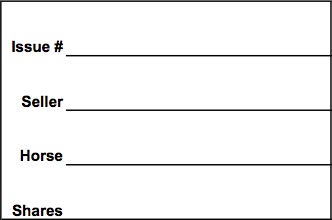
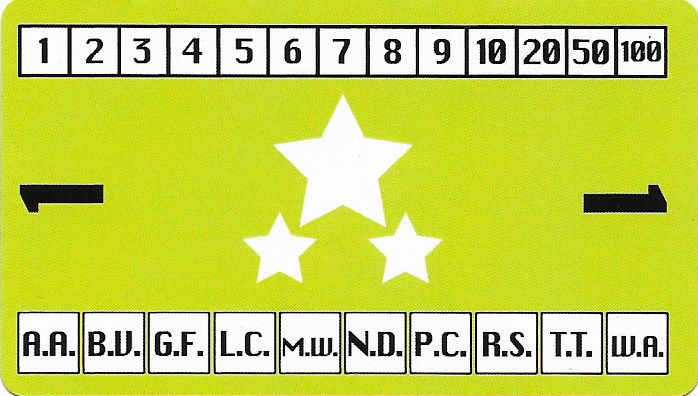
I want players to have a real ‘trading floor’ feel while they played the game.  To make that happen the interface for making bets on the ‘trading floor’ needs to enable speedy trades without wasting time moving around fiddly bits to complete the bets.The solution was to create a betting slip the bookie handed to a bettor with all the information needed for the bettor to collect on their winnings at the end of the race. Initially, I had players hand write the initials of the horse on the betting slip.  Writing initials meant players had to pause, make sure they wrote the right initials, and hope their handwriting was legible. Time was being spent administering the game and not playing the game. Simple fix, replace writing a horse name with circling a horse. Players no longer had to think what is the name of the horse and if the handing writing is legible.  They just swiftly circle the correct horse, move onto the next bet, and keep playing the game.


Second problem, can the mechanic be taught in a reasonable timeframe to players.  Coming up with a solution with the fiddly bits used to play the game does not mean you have solved how to teach players to play the game.  In the early version of the game I had a table which let players track all of their bets they booked during the race. To use it, I taught players the meaning of multiple columns, how you should aggregate things, and the meaning of each row.  While the setup made intuitive sense to an expert player, say the designer of the game, it was a complex and confusing element that extended the rule explanation and over complicated learning the game. Solution, get rid of it all together. Players, I later discover, already know how to make their own lists.  Their personal tracking system they make up on the spot makes sense to them because they created it. Getting rid of the table also reduced the time to teach the game because I do not have to teach them the way I like to make a list.

Third set of problems, make the game affordable to publish.  Having the greatest idea for a game in the world means nothing if you cannot deliver the game with components that are affordable for players to buy.  Remember my betting slips I mentioned earlier? Well, I failed to mention they were disposable betting slips. You write on one once and at the end of the game you throw it away.  Disposable betting slips, while clear and effective at making the game easy to play and learn, are an expensive nightmare for publishing the game. The innovative tools to solve my earlier challenges must be refined again.  How about dry erase board slips. Dry erase markers are not cheap. But multi-colored clips on a card clearly communicates the key information from the old betting slips and is made from off the shelf cost effective components.


Patience is needed to address the problems of implementing a new real world mechanic.  There will be multiple problems that will need to solve. In the case of Bookies & Bettors, I spent years solving how to make the game playable before I was able to spend additional years solving how to create a version with the right sort components to be economical to publish.  

Big Picture

A Real World Mechanic is best used when a series of strategic choices people make in the real world is ported into a board game.  Numerous real world mechanics are a powerful enough experience they do not need to be overshadowed with other mechanics that distract you from a new exciting strategic experience.  Designers just need to make sure they understand what part of the real world mechanic they want players to experience and how to remove things in their design distracting them from the core experience.  Refining a real world mechanic into a playable game will challenge designers, and requires patience to work through all the steps to develop a successful real world mechanic game.

Tuesday, November 13, 2018

Implementing a Real World Mechanic

Implementing a real world mechanic is hard for many designers because they are too tempted to keep too much of the real world in their board game. When designing, I preserve the experience of the mechanic in the real world, even though I do not always preserve the theme.  In the real world, that mechanic is part of a larger more complicated system that can be too complicated to implement in a board game. When I implement a real word mechanic there is a particular aspect of the mechanic I want players to experience.

The first step to utilizing a Real World Meachic is to distill the mechanics down to most basic components and purpose.  This simplicity focuses in on the fun in the singular real world mechanic. Stock is a form of cooperation. Stock enables people to form partnerships that divide ownership within something that they can easily trade.  Stock is also part of a larger financial system that interacts with banks, bounds, hedge funds, etc that complicates what stocks can do and is not part of the experience of stocks I want to partake in my board game design of Hoboken. Hoboken is about the experience of using stock to work together in a competitive environment.


In Hoboken players are hotel operators trying to build new developments along the waterfront of Hoboken. No single player has the cash on hand to construct these hotels and no means of obtaining new cash until a hotel has been built. The only way to get a hotel constructed is by forming partnerships with other players, splitting ownership and the potential income in future turns.  By removing many other means of raising capital investment found in the real world, players in Hoboken focus on the fun of negotiating the price of a share, deciding how to divy up ownership in a new construction, and who they want to form partnerships with to build their real estate empire. Players are not sidetracked from the core real world mechanic by unnecessary themes or actions.

Thursday, November 8, 2018

Real World Mechanic

The real world is fun. The real world contains a variety of ways to make strategic choices, dare I say game mechanics. These mechanics are games, but a lot of people do not realize they are games. If you sit a person down and try to teach them the concepts, they may think it’s too complicated, or get board and not pay attention.  But if I sit that person down at a board game, teach them some rules with a win condition, they'll pick it up quickly, and may even find their good at it.  Odds are decent, they already have developed skills to utilize the mechanic because they unknowing use it already in their everyday life.
What does a real world mechanic look like? Let’s say you wanted to make a game about building a treehouse using Real World Mechanics.  A real world mechanic would focus on the physical actions taken to build a treehouse, say hammering a nail in a 2x4. While building a treehouse is a wonderful theme, the mechanic of hammering a nail into wood does not excite me.  Notice that when talking about Real World Mechanics I focus on the experience of building a treehouse, not the excitement of having a treehouse.  I am bringing strategic decisions from the real world into a game, not necessarily the theme that goes with those decisions.
Inspiration for Real World Mechanics can come from any process. And there are fields of study devoted to translating human behavior in the world, like economics, and political science, which I conveniently like to steal from to make board games. The key thing I look for are processes in the real world where people make strategic choices with other people and porting that experience into a board game.
So what is an example of a real world mechanics I want in a board game. Here is one, mortgage backed securities.  Wait, stop running away and hear me out. I have strategic information telling me who will survive and who will be swept away. I want to use that information to ensure I am the one who survives and others are left holding the bag when things come tumbling down. That is a tense, exciting, and competitive situation, which also happens to be a mortgage back security.  As I said earlier, my goal is to provide players the experience of the real world mechanic, not necessarily the theme. I could have designed a game themed about mortgage backed securities, but instead I themed a game as life in the mob.


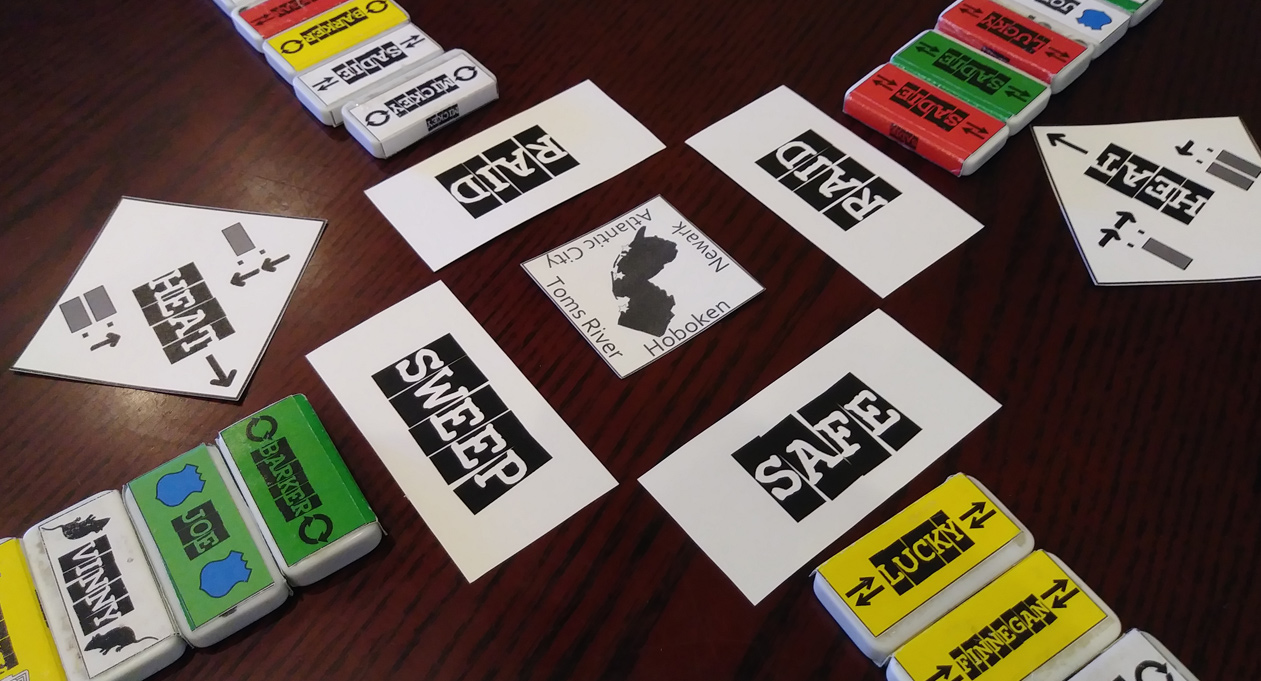
In New Jersey Syndicate you carefully place your goons in cities. Goons placed earlier in the city are less likely to be picked up by the FBI than goons played later in a city. Players are scouting the riskiness of each city while trying not to give away their inside knowledge on risk to their competitors in an effort to gain a competitive edge.  Eventually, the game comes to a climatic end where players learn if they made a sound strategic placement of their goons or if the FBI is sweeping up all their goons, blocking them from becoming the new Don of the New Jersey Syndicate.

No where do players think they are partaking in a game of mortgage back securities. New Jersey Syndicate lets the players experiencing the excitement that takes place within the mortgage back securities market without ever learning about the intricacies of the mortgage back security market.  More importantly, porting a real world mechanic into the game enables me to provide players with a fun new game experience they have not seen in other board games.

Thursday, April 12, 2018

Colloquium on Games of Strategy: Chapter 11

Click here to directly download the MP3

Click here to watch the unedited version on Youtube

Welcome to the Colloquium on Games of Strategy.  Games of Strategy is a textbook on game theory written by Dixit (not the game), Skeath, and Reiley that we are reading to help improve our analysis of board games and board game design.  Paul Owen (owns 3rd edition) and I (own the 2nd and 1st editions) record a discussion about a chapter or two from the book every few weeks.

In the eleventh episode we talk about the Prisoner's Dilemma in board games.  Highlights include a discussion on different ways Paul's wife will prevent him from ever ratting her out to the police, multiple ways of escaping the Prisoner's Dilemma within a game, and how repeatedly paying games with a group of people creates an opportunity to escape the Prisoner's Dilemma within board games.

Note: Aaron misspoke when he said gambling is not a zero sum game.  Aaron was trying to emphasise that games with gambling can provide a marginal benefit or loss that changes player behavior when compare with games where either a player just wins or loses (e.g. a 12 run win and a 1 run win in baseball is still one game win).

You can find our previous discussion on Games of Strategy here.

Tuesday, November 14, 2017

Colloquium on Games of Strategy: Chapter 9


Click here to directly download the MP3

Click here to watch the unedited version on Youtube

Welcome to the Colloquium on Games of Strategy.  Games of Strategy is a textbook on game theory written by Dixit (not the game), Skeath, and Reiley that we are reading to help improve our analysis of board games and board game design.  Paul Owen (owns 3rd edition) and I (own the 2nd and 1st editions) record a discussion about a chapter or two from the book every few weeks.

In the ninth episode we talk about how players respond to uncertainty and information within games.  Highlights include a discussion on the benefits of holding asymmetric information and tactics to counter your opponent's information edge.  Can players provide a creditable signal in your game or is everything just cheap talk.

You can find our previous discussion on Games of Strategy here.

Tuesday, October 10, 2017

Colloquium on Games of Strategy: Chapter 8


Click here to directly download the MP3

Click here to watch the unedited version on Youtube

Welcome to the Colloquium on Games of Strategy.  Games of Strategy is a textbook on game theory written by Dixit (not the game), Skeath, and Reiley that we are reading to help improve our analysis of board games and board game design.  Paul Owen (owns 3rd edition) and I (own the 2nd and 1st editions) record a discussion about a chapter or two from the book every few weeks.

In the eighth episode we talk about games with mixed strategy nash equilibrium.  Highlights include a discussion on the effectiveness of mixed strategy nash equilibrium when other players cannot do math and the growing importance of knowing game theory at the start of the design process when players are going to repeatedly play your game. 

I cannot help but also point out we took some time in this episode to rip on our good friend Keith Ferguson whose game Santa's Workshop is coming out December 2017.  (Great game, you should buy it).

You can find our previous discussion on Games of Strategy here.

Tuesday, September 26, 2017

Colloquium on Games of Strategy: Chapter 7


Click here to directly download the MP3

Click here to watch the unedited version on Youtube

Welcome to the Colloquium on Games of Strategy.  Games of Strategy is a textbook on game theory written by Dixit (not the game), Skeath, and Reiley that we are reading to help improve our analysis of board games and board game design.  Paul Owen (owns 3rd edition) and I (own the 2nd and 1st editions) record a discussion about a chapter or two from the book every few weeks.

In the seventh episode we talk about zero sum games with mixed strategy nash equilibrium.  Highlights include a discussion on if a mixed strategy equilibrium takes away meaningful decisions from the players.

You can find our previous discussion on Games of Strategy here.

Tuesday, July 25, 2017

Colloquium on Games of Strategy: Chapter 6


Click here to directly download the MP3

Click here to watch the unedited version on Youtube

Welcome to the Colloquium on Games of Strategy.  Games of Strategy is a textbook on game theory written by Dixit (not the game), Skeath, and Reiley that we are reading to help improve our analysis of board games and board game design.  Paul Owen (owns 3rd edition) and I (own the 2nd and 1st editions) record a discussion about a chapter or two from the book every few weeks.

In the sixth episode we talk about games that combine simultaneous and sequential move games as well as about strategically switching between the game types.  Highlights include a discussion on how players can drastically change a game outcome outcome by sutley switching a game from a simultaneous game to a sequential game or vice versa.

Below is a link the Sumo Wrestling paper brought up in the discussion.

You can find our previous discussion on Games of Strategy here.

You can find our next discussion on Games of Strategy here.

Tuesday, May 23, 2017

Colloquium on Games of Strategy: Chapter 5

Click here to directly download the MP3

Click here to watch the unedited version on Youtube

Welcome to the Colloquium on Games of Strategy.  Games of Strategy is a textbook on game theory written by Dixit (not the game), Skeath, and Reiley that we are reading to help improve our analysis of board games and board game design.  Paul Owen (owns 3rd edition) and I (own the 2nd and 1st editions) record a discussion about a chapter or two from the book every two weeks.  

In the fifth episode we talk with Douglas Schulz about his blog post on if the authors of Game of Strategy consider a solo game to be a game.  Douglas's post was inspired by the first episode of the Paul Owen & Dr. Wictz Colloquium on Games of Strategy.

You can find our previous discussion on Games of Strategy here.

Monday, May 8, 2017

Colloquium on Games of Strategy: Chapter 4


Click here to directly download the MP3

Click here to watch the unedited version on Youtube

Welcome to the Colloquium on Games of Strategy.  Games of Strategy is a textbook on game theory written by Dixit (not the game), Skeath, and Reiley that we are reading to help improve our analysis of board games and board game design.  Paul Owen (owns 3rd edition) and I (own the 2nd and 1st editions) record a discussion about a chapter or two from the book every two weeks.  

In the forth episode we talk about continuous simultaneous move games and criticism of Nash Equilibrium in Chapter 5 (there are some differences between editions).  Highlights include a discussion on how certain sequential Euro games are really slow moving simultaneous games and game theory's solution for strategic discussions when there is no Nash Equilibrium.

You can find our previous discussion on Games of Strategy here.

You can find our next discussion on Games of Strategy here.

Wednesday, April 19, 2017

Colloquium on Games of Strategy: Chapter 3

Click here to directly download the MP3

Click here to watch the unedited version on Youtube


Welcome to the Colloquium on Games of Strategy.  Games of Strategy is a textbook on game theory written by Dixit (not the game), Skeath, and Reiley that we are reading to help improve our analysis of board games and board game design.  Paul Owen (owns 3rd edition) and I (own the 2nd and 1st editions) record a discussion about a chapter or two from the book every two weeks.  

In the third episode we talk about their initial discussion on simultaneous move games in Chapter 4 (there are some differences between editions).  Highlights include a discussion how creating simultaneous games creates a false illusions it solves the challenges facing a sequential board game design and how certain sequential games are really a simulations game. 

You can find our previous discussion on Games of Strategy here.

You can find our next discussion on Games of Strategy here

Monday, March 27, 2017

Colloquium on Games of Strategy: Chapter 2

Click here to directly download the MP3

Click here to watch the unedited version on Youtube

Welcome to the Colloquium on Games of Strategy.  Games of Strategy is a textbook on game theory written by Dixit (not the game), Skeath, and Reiley that we are reading to help improve our analysis of board games and board game design.  Paul Owen (owns 3rd edition) and I (own the 2nd and 1st editions) record a discussion about a chapter or two from the book every two weeks.  

In the second episode we talk about their discussion on sequential games in Chapter 3 (they are the same in all editions).  Highlights include a discussion on the limitation of anticipated payouts predicting player behavior and ways to ensure a sequential board game is unpredictable enough to remain relevant for players. 

You can find our previous discussion on Games of Strategy here and the next episode here.

You can also find a write up of Paul Owen's notes from our discussion here.

Friday, February 24, 2017

Colloquium on Games of Strategy: Chapter 1


Click here to directly download the MP3

Click here to watch the unedited version on Youtube

Welcome to the Colloquium on Games of Strategy.  Games of Strategy is a textbook on game theory written by Dixit (not the game), Skeath, and Reiley that we are reading to help improve our analysis of board games and board game design.  Paul Owen (owns 3rd edition) and I (own the 2nd and 1st editions) record a discussion about a chapter or two from the book every two weeks.  

In the first episode we talk about Chapter 1 & 2 (they are the same in all editions).  Highlights include a discussion on the importance of mutual awareness amongst players, signaling, and cooperative vs noncooperative games (Game Theory Style). 

You can find additional notes about the topics and our discussion from the first episode in this post from Paul Owen's Man Overboard blog.

You can listen to the next Colloquium Game of Strategy episode here.

Friday, April 24, 2015

The Danger of Stronger Copyright Laws in Board Games

There has been some rumblings lately about possibly strengthening copyrights laws in board games to protect game mechanics.  Historically (from my non-lawyer layman perspective) copyright laws in board games have been relatively weak.  I recall Dan Yarrington explaining it like this at an UNPUB panel in Delaware. Devices can be patented, brands trademarked, and rules copyrighted - not mechanics.

What did Dan mean when he said rules can be copyrighted - not mechanics?  Dan meant someone cannot copy the rulebook of a game verbatim, but if they can get someone to perform the same set of action (aka mechanic) using a different set of words, it does not violate copyright.

The challenge to this older approach in copyright law is a series of court rulings that appear to provide some sort of copyright protection to game mechanics as well. I argue that strengthening board game copyright law is bad for board game innovation, designers, publishers, and players.  

Discourages Innovation


Innovation itself is the thing most at risk from strong copyright laws.  Innovation takes place when board game designers modify pre-existing ideas.  Take Ticket to Ride, a remarkable commercial success with a mechanic that tweaked and rethemed rummy.  

Most innovation is the process of tweaking older mechanics.  Having an innovative idea to compete over a set of actions does not mean it has been honed into an intuitive or fun package for board game players.  Many different board game designers work hard coming up with tweaks or iterations based on the same mechanic looking to hit the sweet spot for players.

Stronger copyright laws severely limits what mechanics are available for board game designers to tweak.  That by itself reduce the variability of board games.  Even worse, if mechanics were to become protected, a designer with any idea, good or bad, has to constantly worry if their idea infringes on someone else's copyright.

Why such a worry? Because with stronger copyright laws it becomes harder and more time consuming to identify when a designers has or has not violated someone else’s mechanic.  Under the older copyright approach described by Dan, I can read someone’s rules and make sure I am not copying what they are doing.  Under a system that protects mechanics I have to spend hours and hours of time researching or money on a board game copyright expert to make sure my game is unique.

The problem is the financial reward for making a board game design does not justify paying these costs.  Only a handful of board game designers earn enough money to cover the expense of attending conventions to promote their game designs, yet alone make a living.  Adding additional cost to the game design hobby only pushes more innovative people away from game design and off to doing something else.


Drives out Small Innovative Publishers


Another byproduct is that the cost of making sure a game does not infringe on copyrights drives out innovative small board game publishers.  Board game publishing is a low margin business.  A slight increase in cost across the industry has large implications for the financial viability of many small companies.

The threat of being sued is a big expense.  Keeping a lawyer on retainer, having to drop an additional X amount of dollars for an expert to review the copyright, having to worry about lost man hours dealing with copyright issues in a one/two man company dramatically increases the amount of capital it takes to publish a game.  

To Hasbro, stronger copyright protection is a minimal expense.  For a variety of reasons they already have a fleet of lawyers on retainer.  But for a small one/two man operation -Tasty Minstrel Games, Stonemaier Games, Dice Hate Me Games, Stronghold Games - it's very unlikely they have a legal team on hand for production runs of a few thousand a game.  Even worse, when there is a legal issue it will take up a huge amount of the owner's time to address it because they do not have the budget to push the problem onto a staffer of the company.


Innovation Fallacy


There are some people out there who would respond by saying, but this is all worth it because we will have more “innovative” games.  That, in an effort to avoid licensing fees, board game designers and publishers have to focus on making things that are truly “innovative.”

But this thinking misses the entire point of innovation.  The point of innovation is not to come up with an idea and only use it once.  The point of innovation is to come up with a great idea that is so useful for so many things that we use it over and over again.

Imagine you are the person who invents the wheel.  As a society we are excited someone invented the wheel, not because we necessarily want someone to invent something better than the wheel, but because the wheel is such a great idea we want to use it over and over again for a variety of applications.

We might, as a society, try to do something to award people to come up with the idea for the wheel to encourage the creation of it.  Be it cash prizes, prestige, or even a time period of exclusive use of the idea.  However, at some point we want the idea to be free for all of society to use so we can benefit from the idea and so others can modify it to become an even greater idea.  

Current Copyright protection in the United States lasts either 70 years after the death of the creator, 120 years after first creation, or 95 years after publication.  That means the game Trains, which tweaks the deck building mechanics created by Donald X. Vaccarion for his game Dominion, would have to wait 70 years till after Vaccarion’s death to publish if it failed to  secure his permission to use the deck building mechanic.  Odds are good Hisashi Hayashi would be dead by then and Trains would be one of the many innovative board game casualties from burdensome copyright protection of board game mechanics.

Friday, January 16, 2015

Trade Mechanic Equilibrium in Board Games


Ever reach a point in a trading game when players no longer trade?  That dreadful part of Monopoly where all the properties are traded into monopolies and all there is left to do is to chuck dice until someone wins the game.

Why do trade games freeze?  Trade games freeze because players no longer have any trades that make both parties better off.  When I engage in a trade both the person I trade with and myself are better off from the trade.  But, it is possible that there are a limited number of transactions within a game where that is true.  

If there is a fixed amount of resources in the world, trade makes people better off by sorting the resources to the people who value them the most.  Imagine we are splitting two bags of M&M’s in a room full of board game players.  Initially, we randomly distribute the M&M’s to the players. Then we assign each player a different color they should collect.  If a person who only wants green M&M’s trades 3 brown M&M’s to a person who wants as many M&M’s as possible in exchange for one green M&M, both are better off.  In this world, their trade does not create new M&M’s, their trade only redistributes the M&M’s, but the players are richer as a result.  

As long as no new additional M&M’s are created, and assuming people maintain the same preference for particular types of M&M’s, eventually there will be a point where no one can make a trade that will make someone better off.  If I only want yellow M&M’s and I have, through trade, gotten ahold of all the yellow M&M’s, then there are no more trades that exist that will benefit me.  At some point, every person trading M&M’s will hit this constraint, be it from the lack of having something to trade for what you want or from collecting all of the M&M's you desire.

Economists consider this point when there are no longer any possible trades that make people better off to be an equilibrium.  When equilibriums occur, trading ends.  If trade is a phase in your game, then equilibrium is when players should move onto the next phase of your game, if you do not move on then basically your players are sitting around doing nothing.  

But what if you don’t want to move on?  What if trade is not a phase, but the main mechanic of the game?  What can board game designers do to keep players trading?

Designers options can be broken into two broad categories.  Category one - change the preferences of the players playing the game.  Category two - change the amount of resources available to trade.  

Changing Players Preferences

Players reach an equilibrium because their current set of preferences have been fulfilled.  If I can only earn victory points by collecting sets of five bricks and two wheat then I no longer have any motivation to trade for anything else (unless it helps me get three stones and two wheat).  Furthermore, if I successfully have traded for all the possible sets of 5 brick and 2 wheat, I no longer have any motivation to engage in trade whatsoever.

But what if something happened that changed my preferences?  Say I also have the ability to exchange 3 wheat and 2 stones for victory points.  This changes what sets of resources I want in my hand and pushes me back into the trading market to attempt to acquire the goods I need.

Variability in players trade preferences can also come from varying the payouts of preexisting actions.  Lets say a player always was able to exchange 3 wheat and 2 stones or 5 brick and 2 wheat for victory points, but what changes is how much victory points each sets earns relative to the other.  This change in relative value changes the value of cards in a players hand and potentially stimulates more trade.

How a game shifts players preferences can vary.  Some games may give players exogenously varying goals where the game instructs the players what is the change in the payout for particular actions. This can be done with dice, cards, etc.  Take the game of Compounded.  Each player has the opportunity to trade elements with other players.  The value of having a particular element will change because the compounds available to be created to earn victory points vary throughout gameplay.  New compounds, dictating the value of each element, become randomly available as they are drawn from the deck.

Other games, like Post Position, alter goals with an endogenous mechanics.  An endogenous mechanic is when players actions empower them to manipulate the victory point value of certain actions/positions/holdings through gameplay.  

Players in Post Position engage in trade by making bets for or against a horse.  For one player to bet a horse is going to do well, they have to entice another player to make a trade with them by betting a horse is going to do poorly.  These bets are based on each player’s expectations (aka preferences) on how they think the race is going to play out.  

The expected outcome of the race comes from inputs by the players.  Before each betting round players secretly submit 2 or 3 horses they wish to move up in the race.  The ability of players to endogenously manipulate the position of the horses alters players preferences for which horses they wish to bet for or against and keeps players trading with each other until the end of the game.

Altering Resource Availability

Another, more settle way, to stimulate trade is to alter the availability of resources within the game.  Altering resources has the benefit of changing the value of actions without explicitly changing the price for said action.  The price for upgrading to a city in Settlers of Catan may remain at 3 stones and 2 wheat, but the cost to players of achieving that goal and acquiring the 1 VP that goes with it, will vary due to the availability of stones and wheat for them to trade.

Altering resources can occur both from mechanics that increase the number of resources in the game as well as mechanics that reduce the number of resources within the game.  When the robber removes cards from a players hand, say brick, it increases the cost to that player of constructing roads and alters the value that player places on brick.

You might have noticed that altering resource availability motivates trade in two different ways.  First, it changes the overall cost of acquiring a resource.  When there are more or less places where I can acquire the resource, the cost of earning victory points through collecting different sets also changes.  Second, it changes the preferences of players of what resources they desire.  If I lost all of my wood to the robber and I need to build one more road to guarantee the victory points from having the longest road, then my value for wood will dramatically increase because the resource is now scarce within my hand.  These two effects combined potentially changes what combination of goods in players hands where they do or do not benefit from trade.  This variability provides an opportunity to move from a point in the game where player no longer benefit from trade back to a point where they do benefit from trade.

-Thank you to Kevin Kulp and T.C. Petty III for motivating me to write on this topic with our conversations at Congress of Gamers.

Monday, November 3, 2014

Market Mechanic Lecture: Retrospective


The Market Mechanic Lecture series examines different market mechanics to explore how to better use them in board games.  The series makes a point to clarify from an economic perspective what is a market mechanic vs. a market theme. 


There is a concern that people are missing out on good economic mechanics in board games because they associated them with bad market themed games.  By better defining how to use economic mechanics, the series highlights how good economic mechanic are fun for board game players.   Below is a link to all the articles in the series with a few sentences explaining each article's topic.


Articles:

Introduction

The Introduction lays out the concern that people are missing out on good economic mechanics in board games because they associated them with bad market themed games.  To be able to distinguish the two, it defines what is the difference between a market mechanic and a market theme.   


Trade

Trade mechanics are challenging to design  in board games because both players must benefit from engaging in the trade.  A trade mechanic must be a voluntary exchange between players, such as in Settlers of Catan.  A trade theme, like in Acquire, is when players do not make direct voluntary exchanges with each other.


Money

Money mechanics are a tool board game designers can use to simplify board game play.  It makes it easier for players to trade and lets designers communicate certain game rules with a small set of numbers versus a long and complicated spread sheet.

Prices

Price mechanics are a tool that players use to communicate information with each other within a board game.  It allows players to compete over who can best mange and obfuscate information.


Auctions (Most Read)

A game designer who desires to use an auction mechanics will improve their design if they understand the strengths and weaknesses of auction mechanics highlighted in this post.


Credit (Loans) (2nd Most Read)

Whether a game uses a credit mechanic or a credit theme, this post explains how board game designers can improve either by better understanding how both are used in the real world.


Property Rights

Property rights mechanics enable players to have meaningful choices and personal interactions within board games.  Without property rights players cannot engage in trade, use price mechanics, engage in auctions, or use a credit mechanic.

Friday, October 31, 2014

Market Mechanic Lecture: Property Rights

We have gathered here today to celebrate the conclusion of the market mechanic lecture series.  I know some of you have sad faces because you see the word “conclusion.”  Do not be sad, for while the “Market Lecture” is ending, my writing on what board game designers can learn from economics will still regularly appear on this blog.  But before I part this lecture series to undertake other exciting topics, I want to reflect on the market mechanic that makes all meaningful decisions possible in board games--property rights.

You cannot engage in trade, negotiate prices, hold an auction, and make meaningful choices with money without a property right mechanic.  A property right is the right to do or to not do something; to posses a privilege you can elect to use or not to use.  To clarify what this means I will pull some examples of the use of property rights from the real world

Property Rights in the Real World
From your own personal intuition, if I said you owned a car that means something to you.  That means you have the privilege to drive your car to Kalamazoo (granted you also have the privilege to put gas in your gas tank to run your car).  You also have the privilege of choosing to put it on cinder blocks in your front yard and use it as a lawn ornament.  Owning the car means you have the privilege to elect different ways to use it.     

Ownership means you also have the power to exclude someone from using the car.  If I want to drive your car, I need your permission first.  You can exclude people from repairing the car.  A mechanic cannot repair your car unless you give them permission to repair your car.

Not all property rights come from straight up ownership of a good.  Sometimes, you can have property rights over an object you do not directly own.  When you rent a car you do not own the car.  However, you still hold property rights over it.  You were granted a lease that instill upon you privileges you can execute.  These privileges, such as the ability to drive the rental car, are your property, even though it may only provide you with a set of limited temporary actions.

Why Are Property Rights Important
Property rights enable people to voluntarily interact with each other.  All interaction is a form of trade, even a conversation.  If I start talking to you, you have the privilege to select what you can do, you can elect to listen and engage me in conversation or you can elect to walk away from me.  To have a conversation, my talking has to be valuable enough to entice you to trade to me some of your time instead of you using it to pursue a different activity.

Without trade, there is no need for money, there is no need for auctions, there is no need for prices, there is no need for interaction.  To trade, you must be able to confer to a person a privilege, a property right, be it a good or a service.  For example, to acquire the privilege of me rubbing your back, you must exchange with me a privilege I desire, say the privilege of driving your car for a day.

Imagine a world without property, a world where you no longer have the ability to grant or not grant someone the privilege to undertake an action.  In this world, you do not have the property right to choose where to drive your car, you do what you are told.  You do not have the ability to choose whether or not you give someone a back massage, you are told to and you do it. 

Some people will call this world an extreme version of communism.  I personally call this the game of Candy Land.  You do not decide where you move your gingerbread man, the gingerbread men overlords have instructed you where you will be.  The gingerbread men overlords dictate who will be granted permission to stop walking around in endless circles and finish their trot to Candy Castle.  In Candy Land there is no property, there is nothing to trade, there is no need to hold an auction because players do not own any privileges they can exchange with other players. Without property rights the only privilege that exist is the privilege to exist, the privilege to play the game.

To be honest, I want more in my gaming experience than just the privilege to play.  I want the privilege to make meaningful decisions, preferably with some sort of trade and price mechanism involved.  I can only have this experience if the board game, if my life, includes property rights.